Modeling
Rebuilding the full range of shapes a protein moves through, so rare states and hidden pockets come into view.
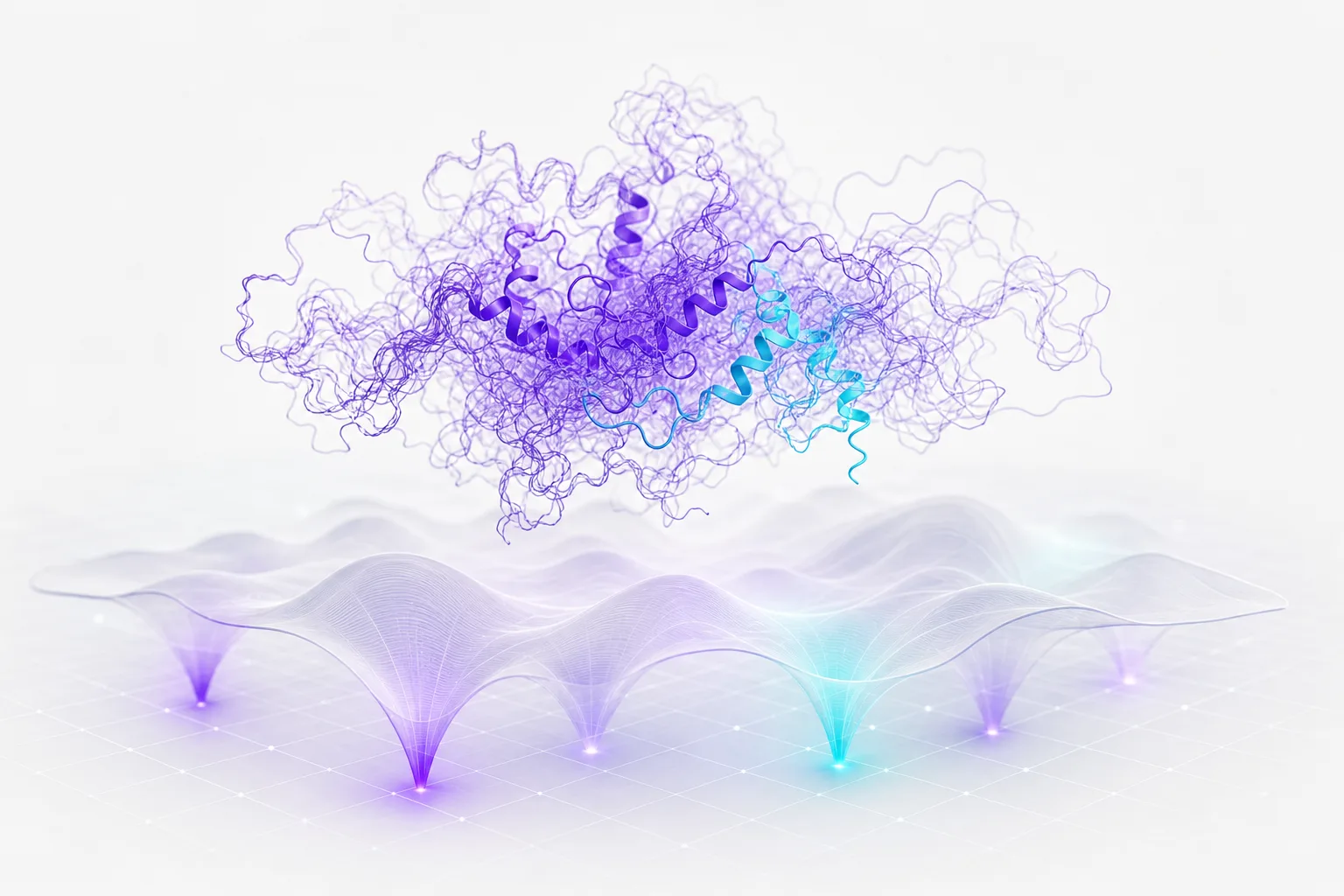
Rebuilding the full range of shapes a protein moves through, so rare states and hidden pockets come into view.
A disordered protein is not one structure. It is a probability distribution that must be measured, simulated, and screened as an ensemble.
A single structure suppresses the motion that defines an intrinsically disordered protein. Peptone instead combines target-specific measurements with physics-based simulation to recover a weighted ensemble of interconverting states.
The workflow moves from experimental protection patterns, through enhanced-sampling molecular dynamics and physiological reweighting, to virtual screening against transient, binding-competent conformations.
HDX-MS protection patterns become sparse restraints that steer HOPES multithermal enhanced sampling across a broad free-energy landscape. Reweighting to physiological conditions surfaces a rare, binding-competent folded state, about three percent of the ensemble, which carries forward to ensemble-aware screening.
Automated HDX-MS reads regional protection while the protein remains in solution. Baseline and ligand-induced changes locate dynamic regions and experimentally supported pockets, anchoring the ensemble without forcing the protein into one fixed structure.
HOPES multithermal sampling lets all-atom simulation escape local traps and visit rare states. Reweighting at physiological conditions yields representative conformers, then independent NMR, SAXS, and mass-spectrometry observables test whether the ensemble agrees with experiment.
Virtual screening runs across population-weighted conformers rather than one structural guess. Candidates advance when their interactions remain consistent across plausible states and stabilize a binding-competent pocket, focusing chemistry on hypotheses supported by both physics and experiment.
Our modeling workloads expand and contract with each target. Enhanced sampling, ensemble generation, physiological reweighting, and compound evaluation each move through a different computational regime, so the platform provisions only the capacity a given stage needs.
Elastic cloud infrastructure supplies orchestration, storage, and on-demand scale, while GPU-accelerated computing and the BioNeMo framework provide optimised tools for molecular simulation, model training, and inference. Together they let Oppenheimer and PepTron-o move target-specific data through the modeling loop without separating computation from the experimental evidence that governs it.
Accelerated computing at Peptone
A short film on the infrastructure behind Peptone's ensemble-first, experimentally grounded drug-discovery platform.